.png?width=500&height=250&name=GWA%20Logo%20(1).png)

Stock Up & Save Upsell - Reliable Discounts, Cart Behavior & Tracking
The Problem
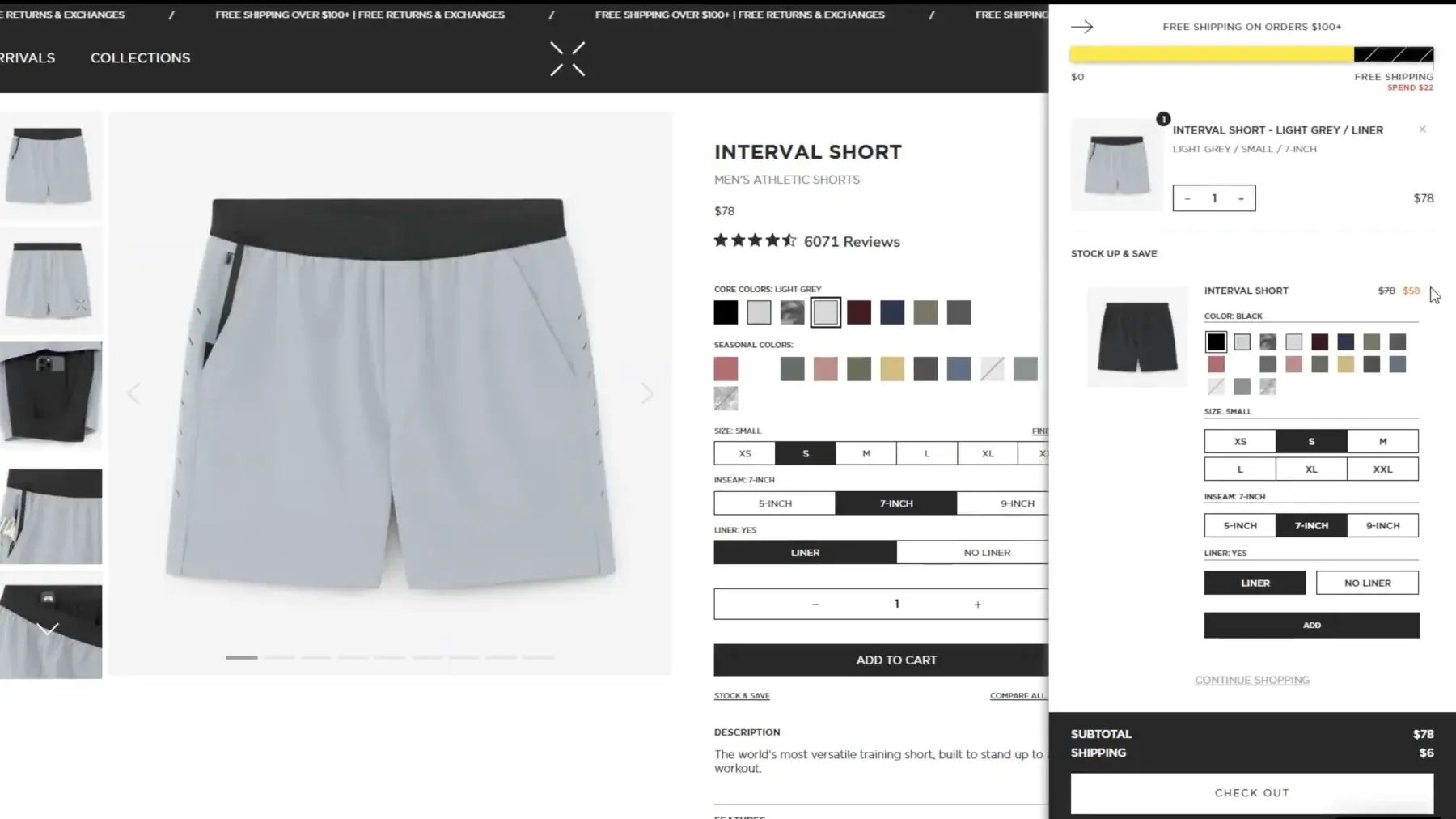
The "Stock Up & Save" upsell behaved inconsistently and created a fragile cart experience. In some cases, the extra pair of shorts added via the upsell block didn't receive the expected discount ("save $20 when you buy two"), and removing an upsell short could clear the entire cart. The team also had no simple way in Shopify to see which orders were influenced by this upsell, and A/B testing ideas, like offering a shirt instead of a second short were blocked by missing configuration and tracking.
The Solution
We rebuilt Stock Up & Save across three areas: discounts, cart behavior, and tracking. Auto-applied upsell discounts were re-enabled in theme settings so the "buy more, save more" logic works reliably. Cart logic was updated so that when the qualifying item is removed, the upsell product stays in the cart and simply loses its discount if the promo conditions are no longer met.
On the tracking side, GTM/GA now fire a dedicated event when "Add to Cart" is clicked in the upsell block, upsell line items carry a custom property, and Shopify Flow automatically tags orders, so performance can be analyzed in Shopify reports and analytics.
Why It Mattered
The updated experience made the core shorts upsell both dependable for customers and measurable for the business. Shoppers now see a predictable "buy two, save $20" mechanic without strange cart wipes or disappearing discounts. For the team, automatic tagging and analytics events turned upsell performance from a black box into a reportable channelL - sessions, revenue and order-level data are all visible. The groundwork for product-mapped upsells also opened the door to A/B tests (an Interval Shirt instead of a second Interval Short, for example) without rewriting core logic each time.
Technical Details
Built on the existing cart upsell system and theme settings. Auto-applied discounts are toggled via Customize. Discount logic ensures that when the cart no longer meets the minimum quantity, only the discount is removed - not the product. Upsell line items carry a property, GTM sends a click event on upsell "Add to Cart" actions, ingested by GA and surfaced in a custom exploration. A Shopify Flow workflow tags new orders depending on upsell type. For future configurations, a global shop metafield stores a mapping table with discount values, so the recommendation logic can be data-driven rather than hard-coded.