.png?width=500&height=250&name=GWA%20Logo%20(1).png)

Linear Actuator Sizing Calculators
Engineering calculators for force, angle and stroke length helping customers select the right actuator model.
The Problem
Customers often struggled to translate their mechanical setup: load weight, geometry, mounting points, opening angle, and number of actuators into the correct actuator specifications. That led to guesswork, mis-sized actuators, and frequent requests to support and R&D to sanity-check calculations. The business had internal spreadsheets and blog content with the formulas, but no user-friendly on-site tool that would automate the math, include safety factors, and lead directly to suitable actuator models.
The Solution
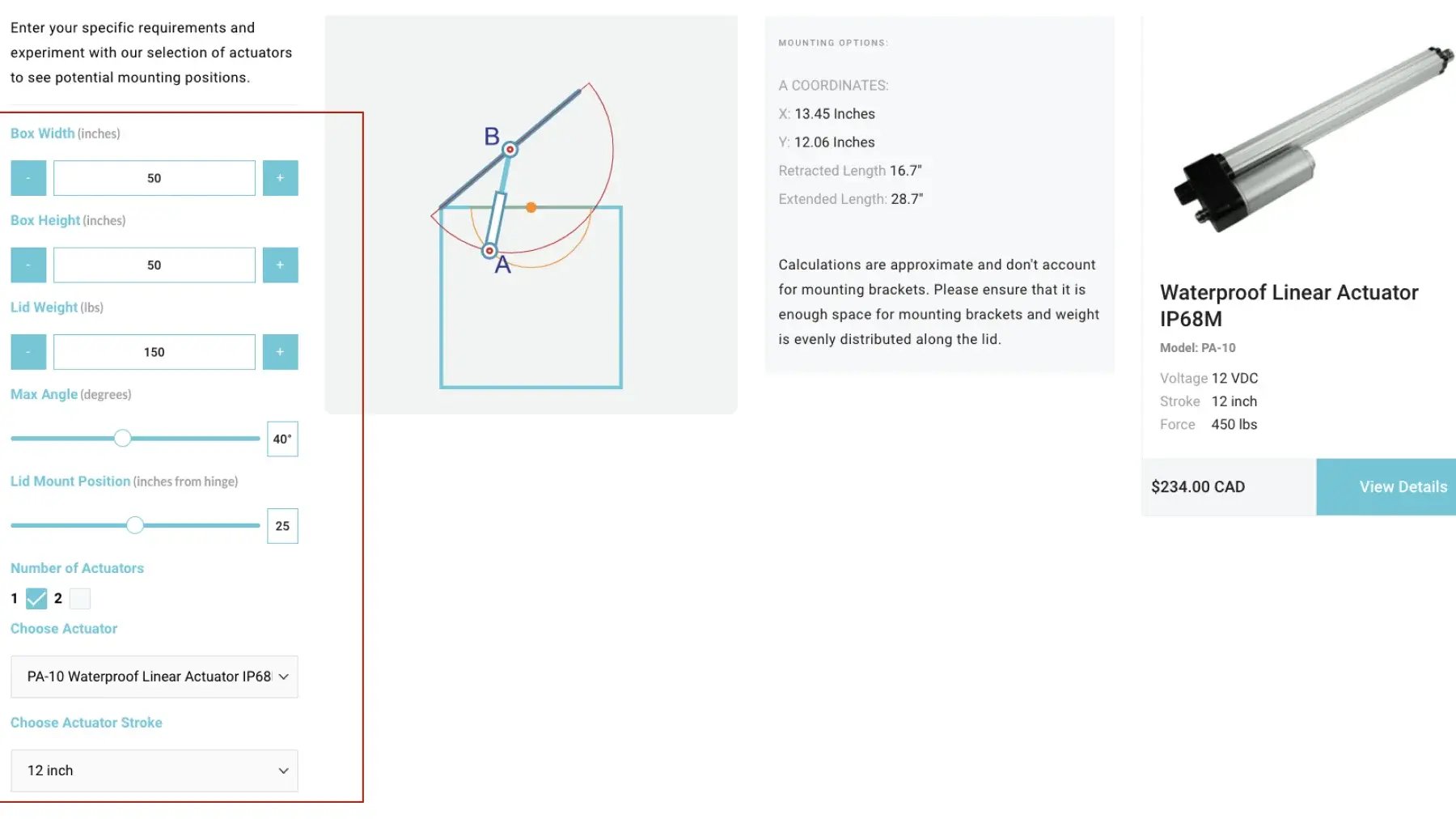
We designed and built a dedicated calculator interface that combines three tools in one experience: a force calculator, an angle calculator, and a stroke length calculator for linear actuators.
Users enter key parameters of load, lid dimensions, maximum opening angle, lid mount position, and number of actuators and can filter candidate models. The engineering logic from the internal spreadsheets was ported into code, including branching by mounting point, weight checks, and an adjusted "worst-case" safety factor agreed with the R&D team.
Based on the inputs, the calculator evaluates which actuators and stroke lengths meet the requirements and lists them in a Recommended section, prompting the user to choose a stroke. If nothing fits, the tool clearly says so and suggests adjusting the max angle, mount position, or model. Contextual notes flag edge cases, like needing a synchronized dual control box when two actuators are used, or recommending the 24VDC option for specific models.
Why It Mattered
The calculators turned a complex sizing process into an accessible self-service flow, cutting reliance on manual spreadsheet calculations and one-to-one support.
Customers can now enter their project geometry and immediately see whether a suitable actuator exists and under what conditions, with clear guidance when adjustments are needed. That improves project success rates, reduces the risk of under-specifying actuators, and channels demand towards technically appropriate models while freeing internal engineering and support teams from repetitive calculation work.
Technical Details
Built as a custom calculator page in the Shopify theme, using JavaScript for engineering formulas and branching logic, and Liquid to load actuator products. Core formulas for force, angle, and stroke length, including worst-case safety factors, were ported from Excel into JavaScript and validated against sample sheets.
The recommendation engine filters products by tags (for example, includes for dual-actuator setups, or excludes from the database) and checks whether each candidate's force rating meets the calculated requirement; only passing models are shown.
The UI handles both successful recommendations and "no suitable actuator found" states, injecting conditional notes for specific configurations. Tested across devices and browsers for stable behavior.